
Olmsted County Court Records After Arrest
The local path is arrest, transport or booking at the Olmsted County Adult Detention Center, a public custody-list entry when the daily roster updates, prosecutor review, a charging document, a Minnesota district court case, hearings, and then disposition, sentence, or release. The jail roster may show "New Charges," "Warrant Arrest," "Pre-Trial," "Probation Violation," "Awaiting Arraignment," or "Awaiting Bail or Bond." Those labels are important, but they are not the same as a certified court record.
Formal court records after an Olmsted County jail arrest are found through Minnesota district court access and local court administration. The Minnesota Court Records Online Case Search, usually called MCRO, provides remote access to many public case records. The Minnesota Judicial Branch warns that MCRO is not the official certified record. Certified copies must come from court administration. For custody and booking details, use the Olmsted County jail inmate records page and the ADC roster instead of treating MCRO as a live jail list; booking photos are covered separately with Olmsted County jail mugshots.
Search Olmsted County Court Records After Arrest
MCRO is the main online court case portal for Olmsted County District Court. It can show limited case, hearing, register-of-actions, judgment, monetary judgment, and public document information. Remote access limits can affect the search. Pending criminal, traffic, and petty misdemeanor cases with no conviction may not return in a defendant-name search, although they may return by case number. That is why a case number, citation number, or hearing calendar entry can be more useful than a name alone.
- Capture the booking date and charge descriptions from the ADC roster if the person is still listed.
- Open MCRO and search by case number when a case number is known.
- Try defendant-name search, but remember that pending no-conviction matters may not appear by name.
- Review the charge list, case events, hearings, public documents, and disposition fields that are available online.
- Use local court administration for certified copies or records that MCRO does not make available remotely.
The Olmsted County District Court page also matters for court records after a jail arrest. It states that calendars are posted at 7:00 p.m. for the next day and updated hourly beginning at 7:00 a.m. A hearing calendar can help when the arrest is too recent for an easy name-search result.
The official MCRO case search screen is shown below as the research source for the statewide portal.
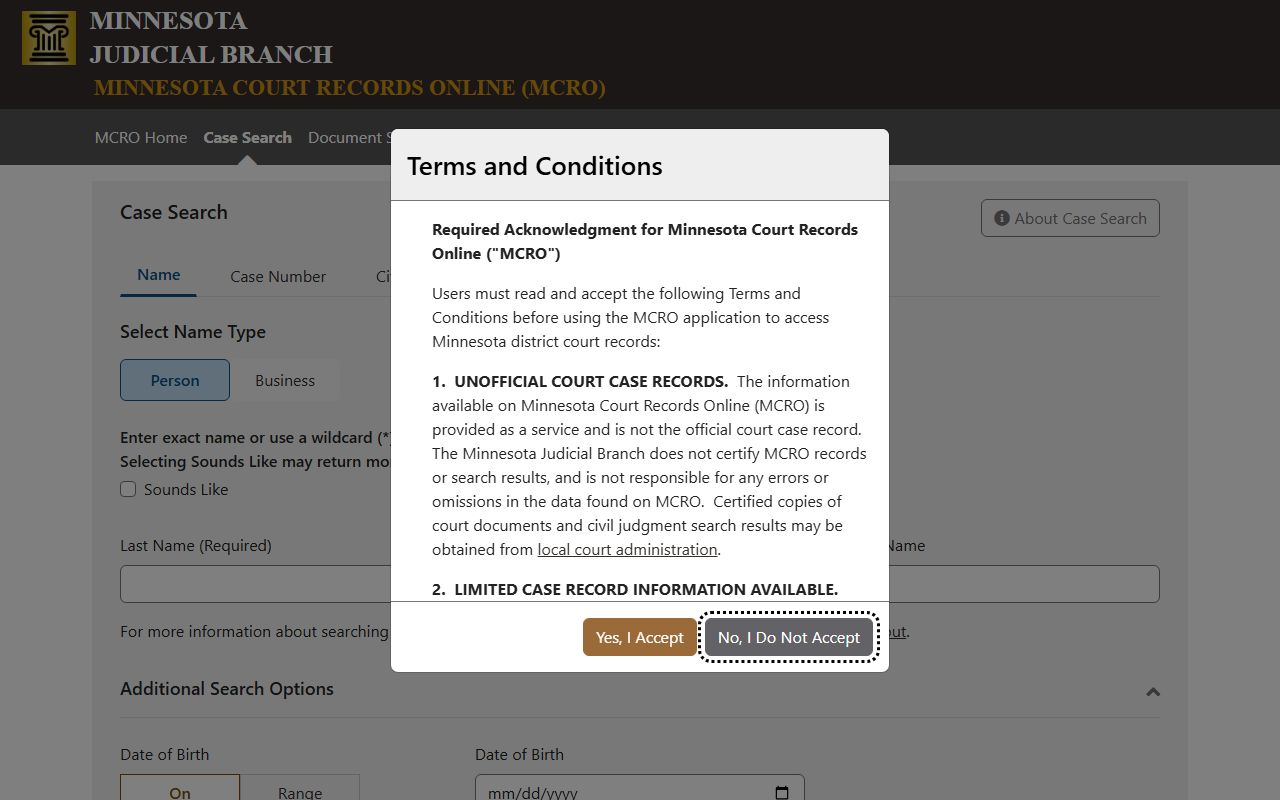
Use MCRO for court case records, not for current custody confirmation or booking-photo access.
Olmsted County Court Search Fields
The court search fields differ from the jail roster fields. A jail roster search starts with a first or last name and gives current custody data. MCRO supports broader case and hearing search paths, including case number and attorney fields. Case number searching is especially important after a jail arrest because pending criminal cases may be restricted from defendant-name results until a conviction or other public access condition applies.
| Field Label | Type | Required | Notes |
|---|---|---|---|
| Case Search | Portal tab | Not applicable | Searches statewide district court cases. |
| Person name | Text | Depends on search path | Name search can be unreliable for pending no-conviction criminal matters. |
| Business name | Text | Optional path | Available in hearing search. |
| Case number | Text | Optional path | Best option when pending charges do not return by defendant name. |
| Judicial officer | Text | Optional path | Used in hearing search. |
| Attorney name or bar number | Text or number | Optional path | Used in hearing search. |
Olmsted County Arrest Charges
Minnesota uses county attorneys, not district attorneys. The Olmsted County Attorney is Michael Walters, named to begin April 21, 2025. The Olmsted County Attorney's Office prosecutes all adult felony crimes in the county, lesser crimes in townships, all juvenile crimes, and provides victim support. Its Criminal Division reviews law-enforcement reports, files criminal complaints, presents grand jury matters where applicable, appears at hearings and trials, and makes sentencing recommendations.
Jurisdiction can shift for lower-level Rochester cases. The Rochester City Attorney prosecutes petty misdemeanor, misdemeanor, and some gross misdemeanor cases that occur within Rochester. The County Attorney handles all felonies countywide and certain gross misdemeanor or misdemeanor matters outside Rochester and in contract cities including Byron, Stewartville, Oronoco, Eyota, Dover, and portions of Chatfield and Pine Island. A booking at the ADC does not by itself identify which prosecutor will handle the final court record.
Note: Booking charges can change when the prosecutor files, amends, declines, or dismisses formal court charges.
Charging Documents After Arrest
A court record after an Olmsted County arrest begins in practical terms when a charging document opens or advances the case. A complaint is common in Minnesota criminal practice and is filed after investigation and prosecutor review. More serious matters can involve grand jury work. The important point for a searcher is that the jail roster charge label is an intake or custody-side entry, while the court case shows the formal charges that the prosecution placed before the court.
| Complaint | Information | Indictment | |
|---|---|---|---|
| Filed By | Prosecutor after law-enforcement review | Prosecutor where procedure allows | Grand jury process |
| Common For | Many Minnesota criminal cases | Cases using that charging path | Serious felony matters |
| Record Effect | Starts or states formal charges | States formal charges | Charges returned by grand jury |
Olmsted County Charge Status
Charge status changes as the case moves. A person can be arrested on one set of suspected offenses, booked into the ADC, then face a different formal charge set after review. Charges may be amended, reduced, added, dismissed, or resolved by plea, trial verdict, diversion, or other disposition. MCRO and certified court records are the places to verify formal status. The BCA Public Criminal History search is conviction-focused and should not be used as the only source for pending-charge checks.
| Status | What It Means |
|---|---|
| Pending | The case or charge has not reached a final disposition. |
| Amended or Reduced | The filed charge changed after prosecutor review, plea talks, or a court order. |
| Dismissed | The charge was ended without a conviction on that count. |
| Convicted | A guilty plea, verdict, or other conviction disposition was entered. |
| Sentence or Release Condition | The court set punishment, supervision, custody, bail, or nonfinancial release terms. |
Bond After Olmsted County Arrest
Bond and release are tied to the court process but often handled through both court administration and the jail. During business hours, 8 a.m. to 4 p.m. Monday through Friday excluding holidays, Olmsted County directs bail payment to Court Administration on the 5th floor of the Government Center at 151 Fourth Street SE. The payer should bring the exact bail amount. The court accepts cash, money order, or credit card, but not personal checks. After payment, the receipt must be taken to the ADC for release processing.
After hours, including holidays, the county directs payers to the Adult Detention Center door in the Government Center circle drive. The payer enters the lobby and picks up the wall telephone receiver. A deputy answers questions and collects the bail needed for release. After hours, exact cash, money order, or a bond from a Third Judicial District approved bail bondsman may be accepted. Personal checks and credit cards are not accepted after hours, and the ADC cannot make change.
| Release Term | How It Works |
|---|---|
| Cash bail | The exact court-set amount is posted with the court or jail process. |
| Surety bond | An approved bail bond agent pledges security for the accused person's court appearance. |
| Personal recognizance | Release without posting money, based on a promise to appear and any conditions. |
| Hold or detainer | Another agency, probation matter, release revocation, or court order may block release even if money is paid. |
Warrants and Court Records
Olmsted County publishes an Active Warrants hub. The Sheriff's Office states that it does not issue warrants. Warrants processed by the Sheriff's Office are issued by Olmsted County District Court in the Third Judicial District and must be signed and approved by a judge. The Civil and Warrants Divisions handle criminal warrants, extraditions, civil process, fugitive investigations, and courtroom security.
A warrant can lead directly to an ADC booking. The roster research found "Warrant Arrest" as an incarceration reason and examples of failure to appear, apprehension order, and probation violation language. Clearing a warrant is not the same as deleting a website listing. A person should confirm with an attorney, court administration, or the warrants line at 507-328-6830 before assuming that a missing web result means no active warrant exists.
Charges Versus Convictions
Court records after a jail arrest must be read by stage. An arrest and charge are accusations or process steps. They are not the same as guilt. A conviction comes only after a guilty plea, verdict, or qualifying adjudication. Minnesota's BCA public criminal history search is useful for public conviction history, but it is not a live substitute for MCRO or court administration when a pending case needs to be checked.
| Charge | Conviction | |
|---|---|---|
| Stage | Accusation filed or maintained in a case | Final guilty result by plea, verdict, or other conviction disposition |
| Proof | Based on probable cause or charging standards | Based on plea or proof beyond a reasonable doubt at trial |
| Where to Check | MCRO, court administration, hearing calendar | MCRO, certified court record, BCA public criminal history when available |
Sealed and Expunged Arrest Records
Minnesota records can be restricted by law, court order, or online-access rules. Minnesota Statutes Chapter 609A governs expungement, which is the sealing of eligible criminal records. Sealing a court record can limit public access, but it does not mean every existing public copy or third-party copy disappears at the same time. Juvenile records, domestic abuse protection matters, child protection, some commitment records, street addresses, and certain documents may also be unavailable remotely even when the court has a record.
| Sealed | Expunged | |
|---|---|---|
| Public View | Hidden or limited from general public access | Sealed under an expungement order or qualifying process |
| Government Access | May remain available to courts or justice agencies as law allows | May still have exceptions depending on the order and statute |
| Eligibility | Depends on record type, outcome, waiting periods, and court order | Depends on Minnesota Chapter 609A and any automatic Clean Slate process that applies |
Restricted Court Records After Arrest
Several Minnesota access rules affect court records after an arrest. Minnesota Statutes 13.03 says government data is public unless classified otherwise. Minnesota Statutes 13.82 covers law-enforcement data, including booking photographs. Minnesota Statutes 13.85 covers corrections and detention data. Minnesota Statutes 13.87 covers BCA criminal history data. These laws help explain why jail, court, and criminal-history systems do not publish the same fields.
For certified court records, contact local court administration. For public jail data that is not on the roster, use Olmsted County's data-practices process. For conviction history, use the BCA Public Criminal History search. Each route answers a different question, and none should be used for employment, tenant screening, credit, insurance, or other FCRA-covered decisions without a lawful consumer-reporting process.
Important: Informal record lookups are not consumer reports and must not be used for FCRA-covered screening decisions.
Public Record Search
Sponsored Results